Pull a few clay tiles off a 1930s roof in the Riviera and you'll usually find the problem right there: felt that crumbles in your hand. From the driveway, that same roof looks perfect. Most leaks on older Santa Barbara homes start this way, and rusted nails, loose flashing at a parapet wall, cracked tile, and an attic that can't breathe round out nearly every repair call we get on houses built before the 1980s.
There are a lot of those homes here. Roughly one in five houses in the city went up before 1940, and the median build year is 1965, so plenty of local roofs sit on decks and flashing that have been through sixty-plus winters.
A roof works as a stack of layers, and each one wears out on its own schedule. Salt air goes after the metal. Long dry summers bake the felt. Then a hard January storm finds every weak spot at once.
Your heating and cooling system feels it too. A hot, damp attic over an older home is one of the big reasons upstairs rooms never quite cool down.
If you're comparing companies for the best residential and commercial roofing repair, maintenance and roof replacement in Santa Barbara, these are the problems worth asking about. How a roofer answers will tell you a lot about who's climbing your ladder.
TL;DR Quick Answers
Best Residential and Commercial Roofing Repair, Maintenance and Roof Replacement in Santa Barbara
The best Santa Barbara roofer is one who looks under the tile, puts the scope in writing, and tells you honestly whether a repair will hold or the roof needs replacing. That's how Quality Roofing has worked since 1996.
Local and family-owned: A Santa Barbara roofing company since 1996, with more than 10,000 roofs completed and a 4.8 out of 5 Google rating.
Licensed and accountable: CSLB #504492, BBB A+ accredited, and a National Roofing Contractors Association member.
Homes and businesses: Roof repair, maintenance, inspection, replacement, reroofing, emergency service, and commercial roofing for property managers.
Built for local roofs: Clay and concrete tile, slate, shingle, synthetic, and flat roofs, with materials chosen for coastal salt air or inland wildfire risk.
Straight answers in writing: A free on-site estimate with a written, itemized scope before you commit.
Backed by a warranty: Qualifying installations carry up to a 7-year workmanship warranty.
Service area: Santa Barbara, Goleta, Montecito, Carpinteria, and the Santa Ynez Valley.
Call (805) 965-2416, Monday through Friday, 7 am to 5 pm, or visit Quality Roofing.
Top Takeaways
Look under the tile. Most leaks on older Santa Barbara roofs come from tired felt, rusted fasteners, or failed flashing beneath tile that still looks fine.
A lift and relay often saves the roof. New underlayment with the original tile put back keeps the home's character and usually costs far less than a replacement.
Watch the parapets. On Spanish-style homes, the seam where a flat section meets a parapet wall hides more leaks than any other spot we check.
Your attic affects your AC. Poor venting traps heat and moisture, rots the deck, and makes the cooling system work harder all summer.
Check the license and get it in writing. Look up any roofer with the CSLB and ask for an itemized scope before work starts.
Why Older Santa Barbara Roofs Fail Differently
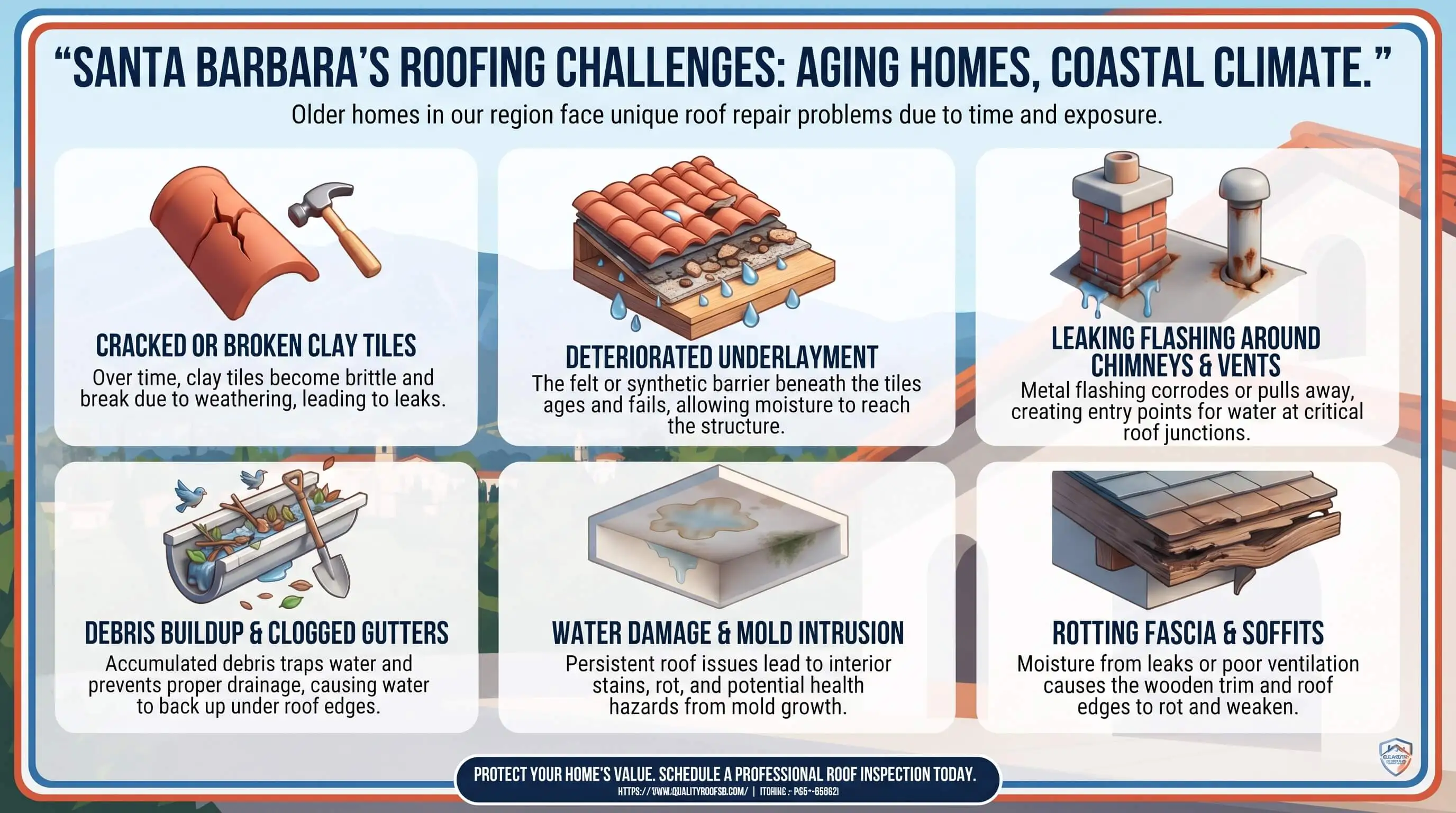
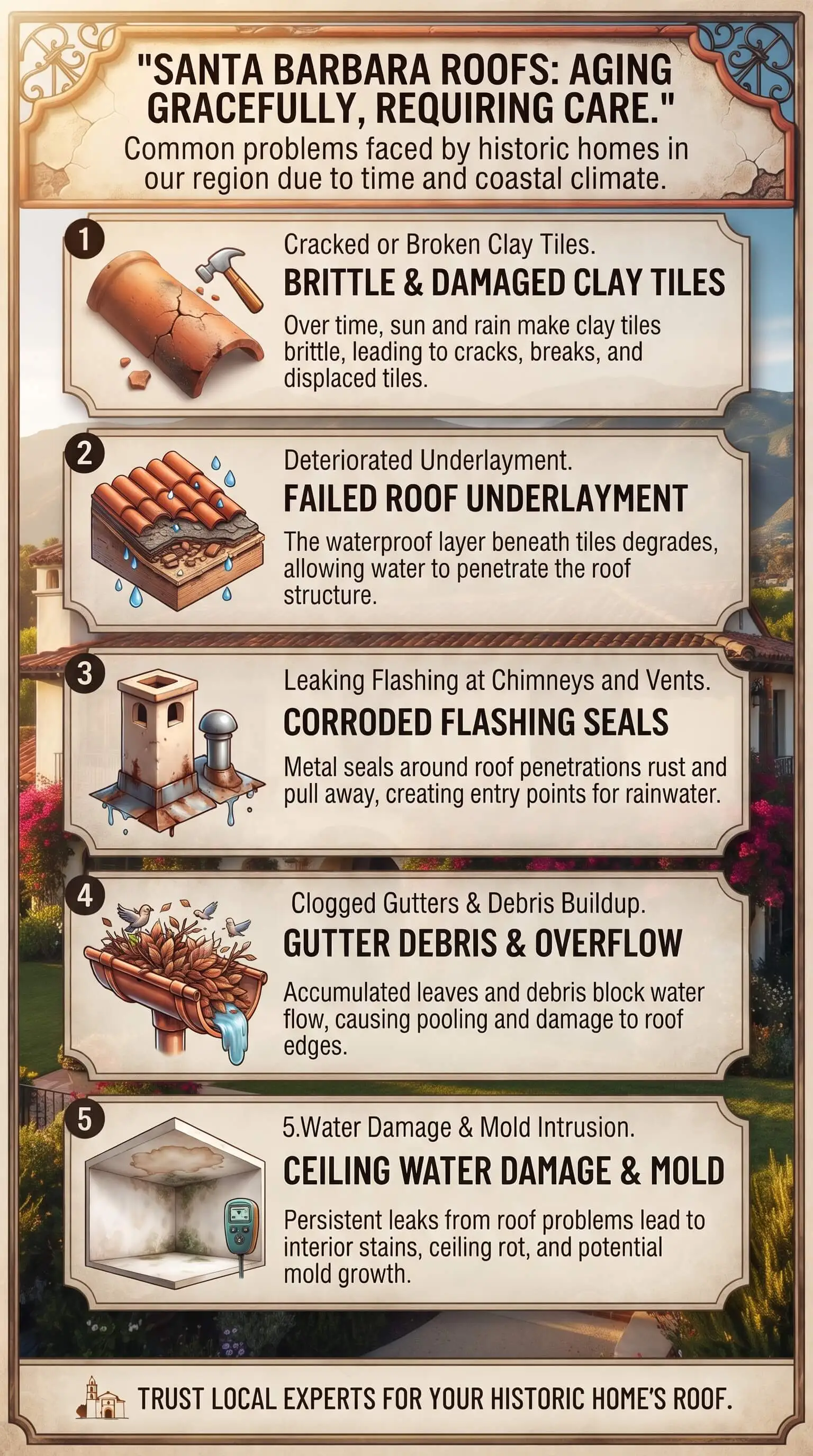
On an older roof here, the part you can see usually outlasts the parts you can't. We'll pull a few tiles on a 1930s Spanish Colonial near the Old Mission and find the clay in good shape, sitting on felt tears like old newspaper.
Local conditions speed that up:
Salt air near the coast corrodes nails, clips, and flashing.
Months without rain dry out the underlayment, and then winter storms hit it all at once.
Hillside homes in Montecito and the foothills catch more wind and debris, plus a higher wildfire risk.
Most older houses carry repairs from several decades, each done a different way by a different crew.
Failing Underlayment Beneath Clay Tile
This is the problem we find most often. Clay tile sheds sun and most of the rain, and the felt beneath it catches whatever gets past. That felt was never built to last as long as the tile, and on a lot of older homes it gave out years ago.
Signs we see over and over:
A ceiling stain with no broken tile above it
Leaks that only show up in wind-driven rain
Felt at the eaves that crumbles when you touch it
Dark, damp patches on the roof deck when you look up from the attic
The usual fix is a lift and relay. We take the tile off, replace the underlayment and any soft deck boards, then put the original tile back. Your house keeps its look, and you aren't paying for tile you didn't need. If moisture has reached the attic's heating or cooling system, an HVAC technician can also check for water damage.
Cracked, Slipped, and Mismatched Tiles
Clay holds up to weather far better than it holds up to boots. Years of foot traffic from patch jobs and antenna installs, a falling branch, a small quake. Any of those can crack a tile or nudge a row out of place.
Matching is the harder part. Manufacturers stopped making a lot of older profiles and colors, and a patch in the wrong tile stands out from the street and may not sit right. We keep salvaged tiles for exactly this. When new tile has to go in, we move originals to the slopes people see and put the new pieces where nobody looks.
Worn Flashing at Chimneys, Parapets, and Walls
Flashing is the metal that seals the seams where the roof meets a chimney, a wall, or a vent. On older homes it's often original, rusted through, or smeared with roofing cement that cracked a few summers back.
Parapets are where we find the sneakiest leaks. Water pools where a flat section meets the wall, slips through a gap, and runs down inside the stucco. By the time it shows on a ceiling, the framing has usually been wet for a while.
Corroded Fasteners and Nail Fatigue
Tile hangs on nails and clips, and those give out well before the clay does. Near the coast, salt speeds the rust along, and some older roofs went up with fasteners nobody expected to last this long.
Once they let go, tiles start sliding. A roof can look tidy one spring and show a crooked line of slipped tile the next.
Poor Attic Ventilation and Dry Rot
Plenty of homes built before the 1980s have less attic venting than today's code calls for. Heat and moisture collect under the deck, and over the years that turns into soft sheathing, dry rot, and sometimes mold.
This is also where your roof and your HVAC system meet. If your ducts run through a hot, damp attic, your air conditioner fights that heat all summer. Professional HVAC system repair can help restore efficiency, improve indoor comfort and keep your cooling system running smoothly. We'd look at the venting if you notice any of these:
A musty smell when you open the attic hatch
Dark or soft spots on the underside of the roof deck
Insulation that feels damp near the eaves
Upstairs rooms that stay warm no matter where the thermostat sits
Ponding and Drainage Problems on Low-Slope Sections
A lot of older Santa Barbara homes pair tile slopes with flat sections behind parapets. Those flat areas only work if the scuppers and drains stay clear. Once leaves block them, water sits for days after a storm and the membrane underneath starts breaking down.
Outdated Fire Ratings in High-Risk Areas
Some older homes in Montecito and the foothills still have wood shake or a roof assembly without a Class A fire rating. CAL FIRE calls the roof the most vulnerable part of a house in a wildfire. If yours needs major work anyway, that's the moment to move to a Class A material like clay or concrete tile, composite, or a rated shingle.
Layers of Past Patchwork
Some roofs we climb have forty years of repairs on them, and you can read the history: tar from one decade, a mismatched tile section from the next, an overlay somebody added later. All of it can hide rot and trap water. When we see several eras of patching on one roof, we look underneath before we recommend one more patch.
Older Roof Problems at a Glance
Failed underlayment: Ceiling stains with intact tile. Typical fix: lift and relay. Urgency: high.
Cracked or slipped tile: Visible gaps or broken pieces. Typical fix: replace or reset tile. Urgency: medium.
Worn flashing: Leaks near chimneys, parapets, or walls. Typical fix: replace flashing. Urgency: high.
Corroded fasteners: Tiles sliding in rows. Typical fix: refasten during a relay. Urgency: medium.
Poor ventilation: Musty attic, hot upstairs rooms. Typical fix: add or balance vents. Urgency: medium.
Flat-section ponding: Standing water after rain. Typical fix: clear drains and repair the membrane. Urgency: high.
Outdated fire rating: Wood shake or an unrated assembly. Typical fix: Class A replacement. Urgency: plan ahead.
Layered patchwork: Mixed materials and tar patches. Typical fix: full inspection first. Urgency: varies.
Repair or Replace: How to Tell on an Older Roof
If the damage sits in one area and the deck under it is solid, repair it. If the felt has failed across the whole roof, leaks keep turning up in new spots, or a big share of the tile is cracked, you'll spend less over time by replacing.
We'll tell you which one your roof needs, and when a repair will hold, that's what we recommend. Homes in a historic district may need design review before work starts, so it pays to begin that conversation early.
Maintenance That Keeps an Older Roof Working
Older roofs don't ask for much, but they ask for it every year:
Book an inspection in early fall, before the rains, and another after the first big storm.
Clear gutters, scuppers, and flat-roof drains each fall.
Have someone check the flashing at chimneys, parapets, and wall joints.
Keep everyone off the tile unless they know how to walk it.
Check the attic after heavy rain for stains, damp insulation, or a musty smell.
"We've been on more than 10,000 roofs around Santa Barbara since 1996, and on older homes the story barely changes. The tile is usually fine, and the trouble is underneath it. On a 1920s bungalow downtown or a '60s ranch on the Mesa, we'll lift a few pieces and find felt that falls apart in our hands, nails rusted through from the salt air, and a parapet seam somebody sealed with tar twenty years ago. From the street, that roof looks great. Inside, the owner has been repainting the same ceiling stain every spring. So we judge an older roof by what's under the tile, and we tell people straight when a repair will hold and when it won't. Doing it right the first time is a lot cheaper than doing it three times."
Essential Resources
If a neighbor asked us where to read up before hiring a roofer for an older house, these are the links we'd send.
Santa Barbara's Own Guidelines for Historic Tile Roofs If your home sits in a historic district or has a classic terra-cotta roof, start here. The City's guidelines explain how local tile roofs go together and point to the underlayment, not the tile, as the usual source of a leak. City of Santa Barbara Historic Resource Design Guidelines: Roofs, Roof Elements and Chimneys
How the National Park Service Repairs Old Clay Tile We'd hand this to anyone restoring an old tile roof. It explains why fasteners and flashing usually fail first and how to fix a roof without wrecking the original tile. NPS Preservation Brief 30: The Preservation and Repair of Historic Clay Tile Roofs
Look Up Any Roofer's License in a Minute California requires a state license for construction work of $1,000 or more in labor and materials [VERIFY]. The CSLB lookup shows whether a license is active and bonded, along with any complaints on file. California Contractors State License Board: Check a License
California's Attorney General on Hiring a Contractor It's short and worth reading before you sign anything. The guide covers getting several bids, checking references, and walking away from high-pressure sales. California Attorney General: Contractors
CAL FIRE's Advice for Hardening a Roof This one is for homes in Montecito, the foothills, or the Santa Ynez Valley. CAL FIRE explains why the roof is the most exposed part of a house and which materials hold up best. CAL FIRE: Wildfire Home Hardening Guide
The Department of Energy on Attics That Last This guide covers ventilation and moisture, and it lists the same warning signs we look for, from wet insulation near the eaves to rotting wood. U.S. Department of Energy: Consumer Guide to Durable Attics
What to Do When a Leak Gets Inside Fixing the roof is only half the job. The EPA explains why wet areas need to dry within 24 to 48 hours and when hidden mold above a ceiling calls for a professional. U.S. EPA: A Brief Guide to Mold, Moisture and Your Home
Supporting Statistics
These three numbers account for most of what we find on older roofs around town.
About 19.6% of homes in the City of Santa Barbara date to 1939 or earlier, and the median home dates to 1965.
That's about one house in five built before World War II. On the roof, it usually means:
Decks, rafters, and attic vents built to codes that are long gone
Original sheathing and flashing left in place under later reroofs
Source: Point2Homes, Santa Barbara demographics from U.S. Census American Community Survey data
Clay tile generally lasts about 100 years, and often several hundred, according to the National Park Service.
That's good news with a catch. The tile almost always outlasts whatever holds it down. Felt wears out first, then nails and clips corrode, and most of the "old tile" leaks we trace turn out to be one of those two. That's why a lift and relay that reuses the original tile is so often the right call here.
Source: National Park Service, Preservation Brief 30
When more than about 30% of a roof's tiles are lost, broken, or damaged, replacing all of the tile may be necessary.
The same Park Service guide gives a useful rule of thumb for the repair-or-replace question:
A handful of broken tiles can usually be swapped for matched or salvaged pieces.
Once breakage spreads, matching gets harder and the patches start to show.
Past roughly a third of the roof, a full retile usually costs less over time than chasing repairs.
We use the same math when we write up a scope, and you'll see it on paper before you decide.
Source: National Park Service, Preservation Brief 30
Final Thoughts
After almost thirty years on Santa Barbara roofs, we judge every older roof by what's under the tile, and we'd urge any homeowner to do the same.
The pattern we see too often
A small stain shows up after the first winter storm.
Someone dabs tar on a flashing seam, and the stain fades.
Two winters later it's back and bigger, and the deck underneath has gone soft.
A job that could have been one section of lift and relay turns into rot repair, drywall, and sometimes a new roof.
Nobody made a crazy decision along the way. Each fix just treated the stain instead of the layer that failed.
What a good outcome takes
An inspection that lifts tile and checks the felt, fasteners, and flashing underneath
A written, itemized scope, so you know exactly what's being fixed and why
A roofer who'll say a repair is enough when it is, and who'll tell you when it isn't
Respect for the original tile and the character of the house wherever that's possible
Older Santa Barbara homes are worth the trouble. Most of their roofs can keep working for decades with the right repair at the right time, and the expensive ones are almost always the roofs where somebody kept painting over the problem. That's why timely roof repair Santa Barbara homeowners can rely on is essential to preventing small issues from turning into costly damage.
Frequently Asked Questions
How long does a clay tile roof last on an older Santa Barbara home?
The tile can go a century or more, but the felt under it usually can't. On older homes here we regularly find decades-old underlayment that's dried out and cracked beneath tile that still looks good. Plan on replacing the underlayment long before the tile, often with a lift and relay that reuses the original pieces.
Why does my tile roof leak when none of the tiles look broken?
Clay tile sheds most of the rain, and the underlayment and flashing beneath it handle the rest of the waterproofing. When those wear out, water gets in even though everything looks fine from the yard. A ceiling stain that shows up after wind-driven rain is the classic sign.
What is a lift and relay?
It's a repair where we take the tile off, replace the worn underlayment and any damaged deck or flashing, then put the original tile back. You keep the look of the house, reuse good material, and fix the layer that actually failed. On older Santa Barbara tile roofs, it's one of the repairs we do most.
Should I repair or replace my older roof?
Repair it if the damage is confined to one area and the deck is solid. Replace it when the underlayment has failed across the roof, leaks keep showing up in new places, or a large share of the tile is broken. An on-site inspection with a written, itemized scope should make the answer clear.
How often should an older roof be inspected in Santa Barbara?
Once a year at minimum, ideally in early fall before the rains, plus a check after any big storm. On older roofs we pay extra attention to flashing, parapet seams, flat-roof drains, and the attic. Catching a worn seam early costs far less than fixing rot or water damage inside the house.
Get a Clear Answer on Your Older Roof
Got a stain that keeps coming back, tiles sliding out of line, or a roof nobody has looked under in years? We'll come out, check what's under the tile, and give you a free estimate with a written, itemized scope before you commit to anything. Quality Roofing has been a family-owned Santa Barbara roofer since 1996, and we'll tell you plainly whether a repair will hold or the roof needs replacing.