This page gives you the baseline every Deltona homeowner deserves before agreeing to any repair — what fair looks like by component, what legitimately drives costs up in this climate, and the questions worth asking before signing anything with top HVAC system repair near Deltona FL. If you've already received a quote and something feels off, this is a good place to start with a trusted local solution.
TL;DR Quick Answers
top HVAC system repair near Deltona FL
Finding trustworthy HVAC repair in Deltona comes down to credentials, honest diagnostics, and knowing what fair pricing looks like in Florida's climate. Here's what matters most:
Verify before you authorize. Every HVAC contractor in Florida must hold an active DBPR license. Confirm it at myfloridalicense.com before anyone starts work.
Know the local price ranges. Common Deltona repairs run $150–$350 for capacitors and contactors, $75–$250 for condensate drain service, and $1,200–$2,500 for compressor replacement. Any quote with no line-item breakdown warrants a second opinion.
Permits protect you. Licensed contractors in Volusia County are required to pull permits for system replacements and significant repairs. A quote that skips permits is transferring risk onto the homeowner.
Florida systems need twice-yearly service. National guidelines recommend once per year. Central Florida's year-round runtime demands early spring and early fall tune-ups to stay ahead of component wear.
Recurring repairs signal a larger problem. Capacitor one year, contactor the next, coil quote the summer after — that's a pattern, not bad luck. When repair costs approach 50% of replacement value, a new system deserves serious consideration.
NATE certification matters. When comparing quotes, technician credentials help explain price differences. A NATE-certified technician's diagnosis carries more weight than one from a technician whose training ends at the state licensing exam.
Top Takeaways
Verify credentials first. Check every contractor's active Florida DBPR license at myfloridalicense.com before work begins. Unlicensed HVAC work in Florida leaves you fully exposed if something goes wrong.
Price alone doesn't tell the full story. Florida's year-round runtime, R-22 refrigerant costs, permit requirements, and system age all affect what a repair legitimately costs in Deltona. Know what's behind the number — not just the number itself.
Recurring repairs are a warning sign — not bad luck. Watch for the pattern: capacitor one year, contactor the next, refrigerant recharge the following summer. When repair costs approach 50% of replacement value, a new system deserves serious consideration.
Chronic problems often point to improper installation — not just failing parts. More than 65% of U.S. residential HVAC systems have been improperly installed. A history of early failures and underperformance may trace back to how the system was installed — not what's been repaired since.
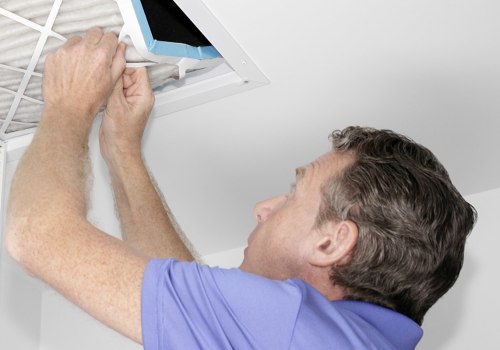
The filter is your system's lowest-cost protection. In Florida's climate, a neglected filter triggers a chain of damage: reduced airflow, coil buildup, motor strain, and premature failure. Changing it on schedule is the single most effective step a Deltona homeowner can take to avoid preventable repairs.
What Drives HVAC Repair Costs in Deltona FL
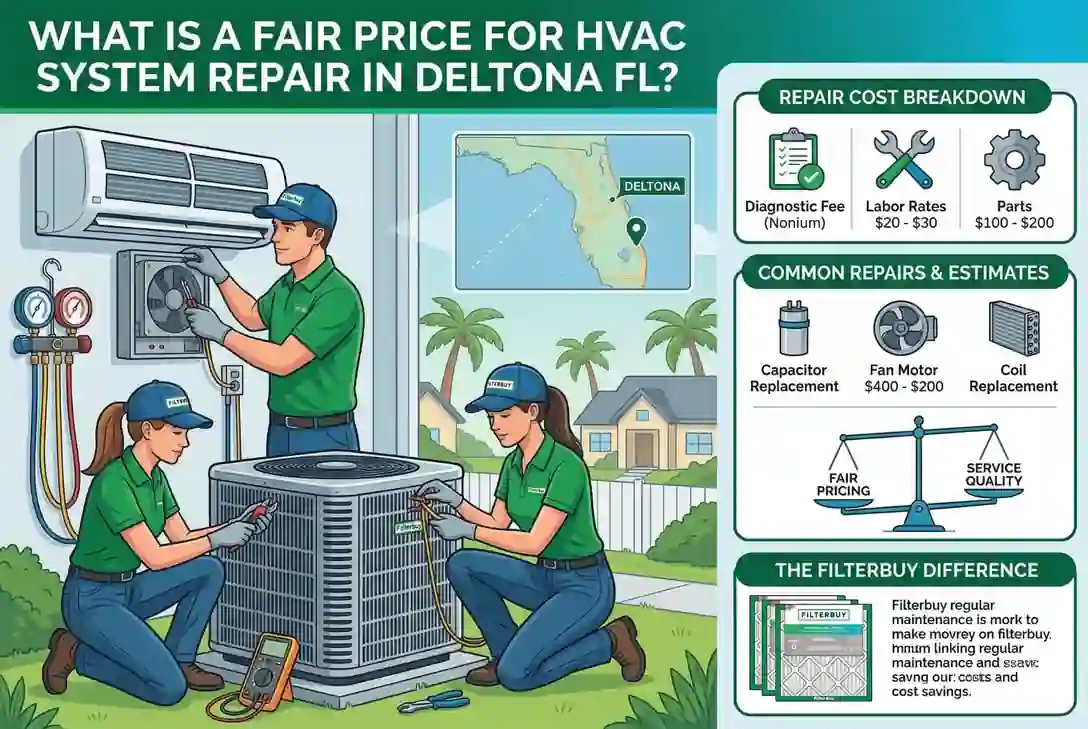
Repair pricing in Deltona is shaped by factors that don't apply equally across the country. Central Florida's heat and humidity push specific components — capacitors, contactors, drain lines, and coils — harder than systems in cooler climates, which means those parts fail more frequently and factor more prominently in local repair bills. Labor rates in the Deltona area also reflect the cost of operating a licensed, insured, permit-pulling contracting business in Florida — which is meaningfully different from what an unlicensed operator might quote you through an HVAC repair service. Understanding what's behind the number on an estimate is the first step toward knowing whether it's fair.
Common HVAC Repairs in Deltona and What They Should Cost
These are the repairs we see most frequently on Central Florida service calls, and the ranges that reflect honest, licensed work in this market:
Capacitor replacement: $150 – $350. One of the most common failures in Florida's heat. Capacitors help start the compressor and fan motors — and they degrade faster here than nearly anywhere else in the country.
Contactor replacement: $150 – $350. Works alongside the capacitor to control the outdoor unit. Also highly vulnerable to Florida's heat load.
Condensate drain line flush or repair: $75 – $250. Algae buildup in Deltona's humidity makes this one of the most frequent service calls we run. Often preventable with routine maintenance.
Thermostat replacement: $150 – $450. Varies significantly based on whether the replacement is a standard unit or a programmable smart thermostat.
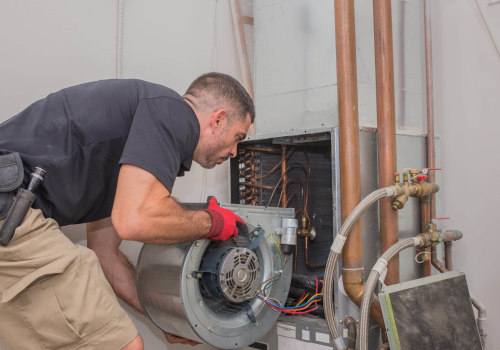
Blower motor replacement: $350 – $700. A mid-range repair that affects airflow throughout the home. Often misdiagnosed — a second opinion is worth considering before authorizing this one.
Evaporator coil replacement: $700 – $1,500. A significant repair. If your system is more than ten years old, a coil replacement conversation should also include a replacement cost comparison.
Refrigerant recharge: $200 – $600. Pricing depends on the refrigerant type your system uses. Older R-22 systems cost significantly more to recharge — and parts availability is shrinking.
Compressor replacement: $1,200 – $2,500. The most expensive single-component repair on this list. At this price point, full system replacement is almost always worth evaluating side by side.
What Makes a Repair Quote Higher — and Whether That's Legitimate
Not every higher quote is an unfair one. Several factors legitimately drive repair costs up in the Deltona area:
Emergency or after-hours service. Same-day and weekend calls carry a premium. In Florida's summer heat, that premium is often worth paying.
Refrigerant type. Systems running on R-22 refrigerant — common in homes built before 2010 — cost significantly more to service as the refrigerant is phased out and supply shrinks.
Permit requirements. Licensed contractors in Volusia County are required to pull permits for certain repairs and all system replacements. That cost is real, legitimate, and protects you — it should appear on your estimate, not be absorbed silently or skipped entirely.
System age and condition. Technicians working on older, neglected systems take longer. Corroded connections, seized components, and deteriorated ductwork all add legitimate time to a job.
What Makes a Quote a Red Flag
From our experience in this market, these are the signals worth paying attention to:
A quote with no line-item breakdown — just a single number.
A contractor who doesn't mention permits for a full system replacement.
A price significantly below every other estimate you've received.
Pressure to authorize work before you've had time to review the estimate.
No written documentation of what's being repaired and why.
Repair vs. Replace: How to Think About the Decision in Deltona
The general rule of thumb our team uses with neighbors is straightforward: if a repair costs more than 50% of the price of a comparable new system, replacement deserves serious consideration — especially in Florida's climate, where an aging system is working harder than it would anywhere else. A system that needed a capacitor last summer, a contactor this spring, and now needs a coil replacement is telling you something. Each repair buys time. At some point, the time you're buying gets shorter and the cost per month gets higher.
A trustworthy HVAC technician walks you through both options honestly — with numbers, not pressure.
How to Verify You're Getting a Fair Price in Deltona
Before authorizing any HVAC repair near Deltona, take these steps:
Get at least two written estimates — itemized by part and labor, not a single bundled number.
Verify the contractor's Florida DBPR license at myfloridalicense.com before anyone starts work.
Confirm permit requirements with Volusia County if the repair involves system replacement or significant component work.
Ask about warranty coverage — both on the part being replaced and the labor performing the replacement.
Check for Duke Energy Florida rebate eligibility if the repair leads to a system replacement — completing a free Home Energy Check before installation is required to qualify.
"In our years serving Deltona, the repair calls that concern us most aren't the expensive ones — they're the ones where a homeowner has already paid for two or three smaller repairs on a system that was quietly failing the whole time. A capacitor here, a contactor there, a refrigerant recharge six months later. Each repair felt reasonable at the moment. But added together, they cost more than a new system would have — and the homeowner still ended up replacing it. This is often when homeowners start searching for top HVAC system repair near me to get clearer answers. Fair pricing isn't just about what a single repair costs. It's about whether that repair is the right decision for your specific system, at this point in its life, in a climate that asks more of residential HVAC equipment than almost anywhere else in the country. That's the conversation we'd have with our own neighbors — and it's the one every Deltona homeowner deserves before signing anything."
Essential Resources
When a repair quote is sitting in front of you and you're not sure whether to trust it, the last thing you need is to feel like you're navigating this alone. As your neighbors who happen to be HVAC professionals, here are the exact resources we'd share with any Deltona homeowner trying to make a confident, informed decision before authorizing any repair work.
The First Thing We'd Check Before Letting Any Contractor Through the Door We've seen firsthand what unlicensed HVAC work costs Deltona homeowners — and it's always more than the repair itself. Florida law requires every HVAC contractor to hold an active DBPR license. This free lookup takes less than a minute and could save you from a situation that's very hard to undo. https://www2.myfloridalicense.com/
What Florida's Attorney General Wants Every Homeowner to Know Before Hiring a Contractor This is the resource we'd hand to a neighbor before they signed anything. Florida's Attorney General publishes specific guidance on contractor red flags, how to evaluate estimates, and what legal protections apply when a contractor uses deceptive or high-pressure tactics — exactly the situations we hear about too often in this community. https://www.myfloridalegal.com/consumer-protection/how-to-protect-yourself-contractors
If the Work or the Price Doesn't Feel Right, Here's What to Do Next Honest contractors welcome scrutiny — and the ones who don't are telling you something. If you believe you've been overcharged or misled by a licensed HVAC contractor in Florida, this is the official state channel for filing a formal complaint. We'd rather you never need it. But knowing it exists puts you in a stronger position from the start. https://www2.myfloridalicense.com/file-a-complaint/
Before You Authorize a Costly Repair, Read What the EPA Says First One of the hardest calls a Deltona homeowner faces is whether a repair is worth doing on an aging system. This authoritative EPA resource gives you the unbiased framework for making that decision — the same kind of honest, pressure-free guidance we'd offer if we were standing in your home reviewing your options with you. https://www.energystar.gov/saveathome/heating-cooling/replace
The Federal Resource We'd Recommend to Any Neighbor Comparing Repair vs. Replacement Costs This comprehensive EPA guide covers HVAC repair costs, efficiency ratings, contractor selection, and long-term upgrade decisions — all in plain language. If a repair estimate is making you wonder whether a new system makes more sense, this is where we'd tell you to start. https://www.energystar.gov/products/tools_resources/guide-energy-efficient-heating-and-cooling-hvac-guide
Deltona Homeowners: Check This Before a Repair Becomes a Replacement If a repair quote is pushing toward replacement territory, check your Duke Energy Florida rebate eligibility before authorizing anything. We always encourage neighbors to complete the free Home Energy Check first — because qualifying for up to $300 back on a new system requires that audit to happen before installation begins, and it costs you nothing to find out. https://www.duke-energy.com/home/products/home-energy-check
Why the Technician Behind the Quote Matters as Much as the Number on It After years of working in this community, we've learned that the difference between a fair repair quote and an inflated one often comes down to who's doing the diagnosing. NATE certification is the most credible independent signal that a technician's skills have been verified beyond the state licensing exam. This directory helps you find certified professionals near Deltona — and gives you a meaningful benchmark when quotes don't add up. https://www.natex.org/consumers/find-a-nate-certified-professional/
These essential resources help Deltona homeowners verify licenses, understand contractor protections, review repair-vs-replacement guidance, and evaluate technician credentials so they can work with a trustworthy HVAC repair technician and avoid costly mistakes before approving any repair.
Supporting Statistics
After years of service calls across Deltona and Central Florida, these numbers stopped surprising us — and started explaining everything.
Air conditioning accounts for 28% of total home energy use in Florida — more than three times the national average of 9%.
We think about this every time we pull up to a Deltona home. Here's what that gap actually means on the ground:
Most of the country treats AC as a seasonal expense. In Central Florida, it's a year-round operating cost.
That distinction changes how a system ages, how components wear, and what a fair repair costs in this market.
When a capacitor fails here after five years, it's not a defective part. It's a part that ran harder and longer than the same component would anywhere north of Georgia.
That context is what separates an honest repair estimate from one that treats your system like it belongs in Minnesota.
Source: U.S. Energy Information Administration, Residential Energy Consumption Survey (RECS) — https://www.eia.gov/pressroom/releases/press535.php
More than 65% of residential HVAC systems in the U.S. have been improperly installed, causing equipment to consume 20%–30% more energy than necessary.
This is the statistic that explains the most frustrating calls we go on. Here's what improper installation actually looks like in Deltona homes:
Unexplained energy bills that don't match the system's age or efficiency rating.
Rooms that won't cool evenly no matter what the thermostat is set to.
Components that fail ahead of schedule — capacitors, contactors, blower motors.
A history of recurring repairs on a system that never worked right from day one.
When our technicians arrive at a home with that pattern, the first question we ask isn't "what broke?" It's "was this system ever right?" That question changes the diagnosis — and it changes what we recommend.
Source: U.S. Department of Energy, Office of Energy Efficiency & Renewable Energy — https://www.energy.gov/eere/buildings/articles/optimizing-installed-performance-residential-hvac-systems
Replacing a dirty, clogged filter with a clean one can reduce an air conditioner's energy consumption by 5% to 15%.
We've walked into Deltona service calls where a system a homeowner thought needed a major repair turned out to need a filter change and a condensate drain flush. In Florida's climate, a neglected filter doesn't just cost efficiency — it triggers a chain of damage:
Airflow drops. The system works harder to move the same amount of air.
Dirt bypasses the filter and accumulates on the evaporator coil.
The blower motor strains under the increased load and wears prematurely.
The system mimics the symptoms of a serious failure — when the actual fix costs almost nothing.
The filter is the least expensive thing standing between your system and our service van.
Source: U.S. Department of Energy, Energy Saver — https://www.energy.gov/energysaver/maintaining-your-air-conditioner
Final Thoughts
After years of repair calls across Deltona and Central Florida, we've learned one thing that shapes every estimate we write:
The price of an HVAC repair is rarely the whole story.
The Pattern We See Too Often
The homeowners who get the worst outcomes aren't always the ones who chose the wrong company. They're the ones who didn't have enough information to recognize a bad situation when it was unfolding. The pattern looks like this:
A capacitor replacement in the spring.
A contractor six months later.
A refrigerant recharge the following summer.
A compressor quote that finally forces the replacement conversation — two years and $2,000 too late.
Each repair felt reasonable at the moment. Added together, they cost more than a new system would have. That's not a contractor problem. That's an information problem.
What a Fair Price Actually Requires
Getting a fair repair outcome in Deltona isn't just about finding a competitive market. It requires knowing:
What questions to ask before anyone starts work.
That a lower quote isn't always a better deal.
Those permits exist to protect you — not to pad a contractor's paperwork.
That a system with recurring repairs is telling you something worth listening to.
Our Honest Opinion
The repair decisions that age well share the same qualities:
Full picture on the table — system age, repair history, component costs, and replacement value evaluated together.
Itemized estimates reviewed before authorization.
A technician willing to tell you when a repair isn't worth doing.
The decisions that don't age well are made under pressure, from contractors more interested in closing a call than solving a problem.
A trustworthy HVAC company in Deltona should be willing to walk away from a repair sale when replacement is the smarter answer. That's not losing business. That's being a neighbor.
We live here too. And that changes how we work.
FAQ on Top HVAC System Repair Near Deltona, FL
Q: How do I know if an HVAC contractor in Deltona is legitimate?
A: Verify credentials before anyone starts work. After years in this community, we've seen what happens when homeowners skip this step — it's always harder to fix after the fact.
Start here:
Verify the contractor's active Florida DBPR license at myfloridalicense.com.
Confirm active liability insurance and request proof of coverage.
Ask whether required Volusia County permits will be pulled.
Check for NATE-certified technicians on the job.
Request a written, itemized estimate — not a single bundled number.
Watch for these red flags:
Can't produce a license number on request.
Discourages second opinions or comparisons.
Goes quiet when permits come up.
Quotes a single price with no breakdown.
Five minutes of credential verification before authorizing work is one of the most valuable things a Deltona homeowner can do.
Q: What are the most common HVAC repairs in Deltona, and what should they cost?
A: Florida's heat and humidity accelerate component wear faster than almost anywhere else in the country. From our years of service calls in the Deltona area, here are the most frequent repairs and honest price ranges for licensed work in this market:
Capacitor replacement: $150–$350
Contactor replacement: $150–$350
Condensate drain line flush or repair: $75–$250
Thermostat replacement: $150–$450
Blower motor replacement: $350–$700
Evaporator coil replacement: $700–$1,500
Refrigerant recharge: $200–$600
Compressor replacement: $1,200–$2,500
Pricing shifts based on:
System age and condition.
Refrigerant type (R-22 costs significantly more).
Permit requirements for the scope of work.
Standard vs. after-hours service timing.
Any estimate with no line-item breakdown warrants a second opinion — regardless of where it falls in these ranges.
Q: When does a repair stop making sense and a replacement become the smarter decision in Deltona?
A: When a repair costs more than 50% of a comparable new system, replacement deserves serious consideration. But repair frequency tells the story just as clearly as cost.
Watch for this pattern:
Capacitor replacement one year.
Contactor the following spring.
Blower motor or coil quote the summer after that.
That's not bad luck. That's a system in decline — and in Florida's climate, that decline moves faster than national guidelines account for.
Additional replacement signals:
The system is 10–12 years old or older.
Running on R-22 refrigerant with shrinking parts availability.
Energy bills rising despite no change in usage habits.
Rooms that won't cool evenly regardless of thermostat settings.
A technician worth trusting puts both options on the table with honest numbers — not the answer that's easiest to sell.
Q: What role do permits play in HVAC repair pricing in Deltona, and why do they matter?
A: Permits are one of the most misunderstood line items on a Deltona HVAC estimate — and one of the most important. From our years working in Volusia County, here's what homeowners need to know:
What permits do:
Verify the installation meets Florida Building Code through independent inspection.
Protect your home's resale value.
Keep your homeowner's insurance valid for the work performed.
Create a legal record that the work was done correctly.
What skipping permits actually means:
The contractor is transferring risk from their ledger onto yours.
The work won't be independently inspected.
You may face complications at resale or during an insurance claim.
When a quote comes in significantly below every other estimate and permits aren't mentioned, that gap is almost always the explanation. We've seen how that plays out for homeowners — and it's never worth the short-term savings.
Q: How often should an HVAC system be serviced in Deltona compared to national recommendations?
A: National guidelines suggest one professional tune-up per year. Based on our years serving Central Florida homes, we recommend twice — early spring and early fall.
Here's why the national standard isn't enough in this market:
Florida systems log significantly more annual operating hours than systems in most other states.
More runtime means faster wear on capacitors, contactors, and coils.
Condensate drain lines clog faster in Deltona's humidity — one of the most frequent service calls we run.
Small problems that stay manageable up north can escalate into major repairs in a single Central Florida summer.
The twice-yearly service schedule for Deltona homeowners:
Early spring — before peak cooling season begins.
Early fall — before the heating season and after the hardest months of runtime.
Twice-yearly service isn't an upsell. It's the maintenance schedule Central Florida's climate actually demands — and the most reliable way to keep repairs off this page entirely.
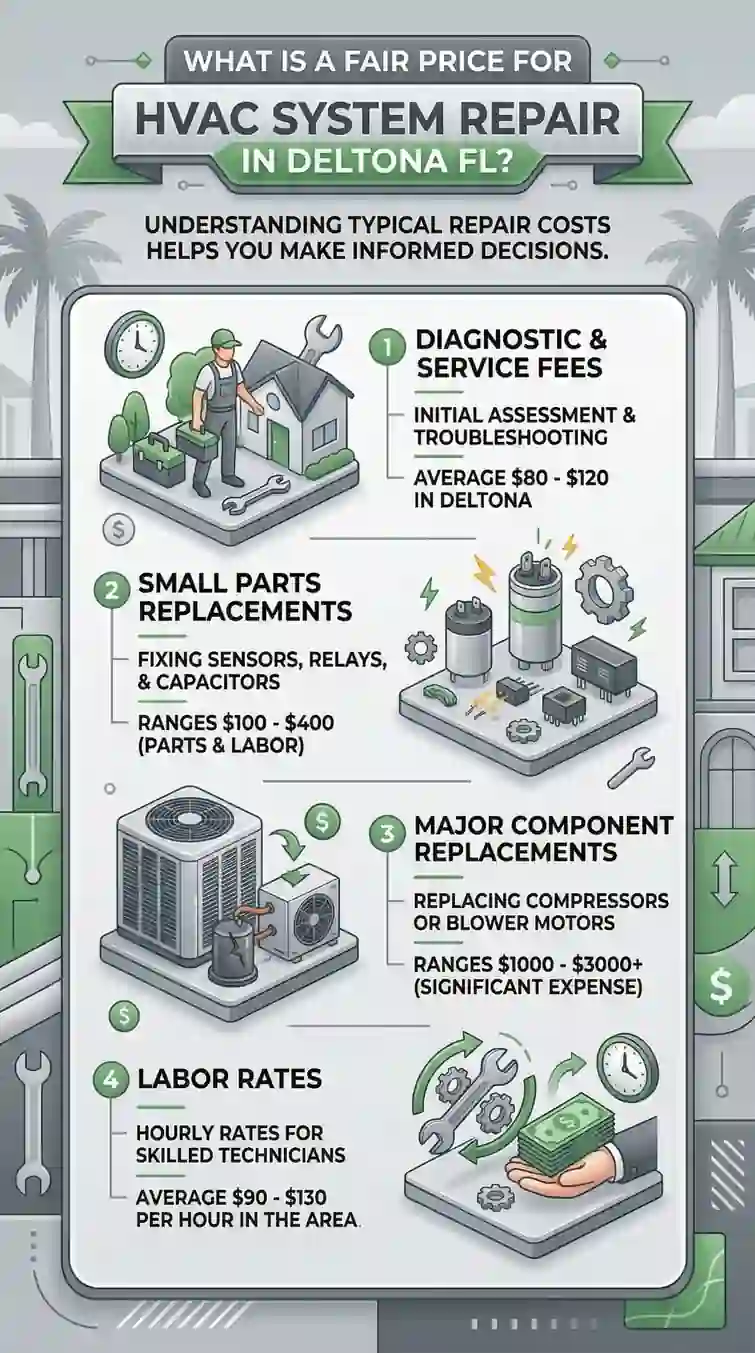
Understanding repair costs is easier when homeowners know what actually affects pricing, which is why What Is a Fair Price for HVAC System Repair in Deltona FL? explains how climate, component wear, and proper diagnostics influence what a legitimate repair quote should include. In many cases, airflow restrictions caused by dirty or outdated filters can also contribute to system strain and unexpected service calls. Replacing filters regularly with options like 21x22x1 pleated furnace air filters helps maintain proper airflow and reduces unnecessary stress on HVAC components. Likewise, 20x20x2 MERV 13 HVAC furnace air filters provide higher-level filtration that captures finer particles while supporting system efficiency. Homeowners can also explore replacement HVAC furnace air filters to keep their systems operating smoothly between maintenance visits. Maintaining proper filtration aligns with the guidance in the article and can help Deltona homeowners reduce the likelihood of avoidable repair costs while protecting long-term HVAC performance.