TL;DR Quick Answers
top HVAC system repair near Clermont FL
Top HVAC system repair near Clermont FL means a licensed Florida DBPR contractor who can diagnose humidity at the component level. We work through system sizing, condensate drains, coil condition, refrigerant charge, and return-side duct leakage. Most calls resolve in a single visit with diagnosis under an hour.
Top Takeaways
Cooling and dehumidifying are two separate jobs your AC handles, and most Clermont humidity complaints come from the system failing at the second one while doing the first just fine.
Oversized AC systems hit set temperature so fast they shut off before pulling enough moisture out of the air. We see this on roughly half of our Clermont service calls.
Clogged condensate drains are the most common single repair we run during Lake County’s wet season, and they almost always cause the humidity problem before they cause the water leak.
Return-side duct leakage in older Clermont attics lets 130°F+ humid air bypass the cooling cycle, which leaves the AC trying to dehumidify air it should never have touched.
Verifying a contractor’s Florida DBPR license at MyFloridaLicense.com takes two minutes and rules out unlicensed operators before any repair work begins.
Why Clermont’s Climate Makes Humidity an HVAC Repair Problem
Clermont’s climate is the reason these calls keep coming. The city sits between the Chain of Lakes and the Green Swamp watershed, and both push the moisture content of outdoor air higher than most parts of the state. From June through September, afternoon storms recharge the dew point almost daily. The EPA recommends keeping indoor relative humidity between 30 and 50 percent to limit mold, dust mites, and that sticky “why does the house feel hot” feeling that lingers even when the thermostat reads low.
Clermont attics make it worse. We’ve measured attic temperatures between 130 and 140 degrees in July on homes from Sawgrass Bay to Serenoa, and any return-side leakage in the duct system pulls that hot, humid air straight into the AC. The system is then trying to dehumidify uncontrolled attic air. It never catches up.
Humidity here is rarely a weather problem on a service call. It’s a repair problem dressed up as one. The system is doing what its components allow it to do, and one of those components has degraded, leaked, or was never sized correctly to begin with. That’s why homeowners trust the top HVAC repair in Clermont to diagnose the actual source of indoor humidity issues and restore proper comfort without pushing unnecessary system replacements. We use that frame on every diagnosis, and it’s why most Clermont humidity complaints resolve without a system replacement.
The Five Most Common HVAC Repair Issues That Drive High Indoor Humidity
Across thousands of Lake County service calls, the same five mechanical issues keep showing up behind humidity complaints. They run in roughly this order of frequency.
Oversized AC, short-cycling at the worst possible time. Florida builders and replacement contractors have a long habit of pushing one ton of cooling per 400 to 500 square feet, which often results in 4 or 5 ton systems on 2,000-square-foot Clermont homes that genuinely need 3 or 3.5 tons. The system hits temperature in 8 minutes, shuts off, and never runs the 30-plus continuous minutes the coil needs to actually pull moisture. ENERGY STAR’s own guidance describes oversized equipment as causing “humidity control problems and inefficient operation.”
Clogged condensate drain. This is the single most common repair we run on humidity calls. Algae and biofilm grow fast in Florida’s warm, dark drain pans, and once the line clogs, water backs up. That can trigger the float switch and shut the system down, or overflow into the secondary pan or the ceiling below. Even partial clogs leave the coil too wet, which dumps moisture back into the conditioned air on the off-cycle.
Frozen or dirty evaporator coil. A clogged filter, low blower CFM, or restricted return drops airflow across the coil. Coil temperature falls below the dew point, condensate freezes, and instead of draining away, it accumulates as ice. Once you see ice on a refrigerant line, the AC has stopped dehumidifying entirely. The system feels weak for a day or two before it stops cooling at all.
Low refrigerant charge. An undercharged AC runs at higher coil temperatures than designed. Higher coil temps mean less moisture condenses out of the air. We’ve found leaks at flare fittings, Schrader valves, and evaporator coil U-bends that homeowners didn’t know they had, quietly cutting dehumidification capacity in half over a season.
Return-side duct leakage. This is the Clermont-specific one. Builders working the city’s late-1980s and 1990s subdivisions ran flex duct through unconditioned attics, and 30 years of UV exposure, rodent activity, and metal-band failures leave tiny return leaks that pull 130-degree attic air into the system. The AC then has to remove humidity from air that should never have entered the duct system in the first place.
How We Diagnose Humidity-Specific HVAC Failures on Clermont Service Calls
On a humidity-driven service call, the diagnosis usually takes 20 to 40 minutes. The process follows a specific order, starting at the air handler.
We start with a humidity reading at three points: the supply register closest to the air handler, a return register, and a central living area. The spread tells us whether the system is dehumidifying at all. A working AC pulls supply air to roughly 50 to 58°F at around 90 percent RH, and the return-to-supply temperature differential should sit between 18 and 22°F.
Next we check static pressure on the return and supply sides of the air handler. High return-side static almost always points to a clogged filter, undersized return ducts, or a coil that’s iced or biologically fouled. Low supply-side static suggests duct leakage or a blower wheel problem.
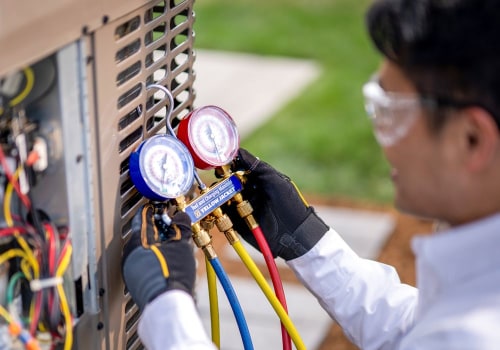
We verify refrigerant charge by superheat for fixed-orifice systems and subcooling for TXV systems. An undercharged unit runs high superheat and low subcooling, and we’ll often catch the leak right at the indoor coil before pulling the unit apart.
We give condensate drains a visual inspection and a flush test. If algae shows up in the line or pan, we treat it on the spot.
Finally, we walk the duct system in the attic. A reliable HVAC repair company understands that airflow and duct integrity are critical to overall system performance, especially in older Florida homes. On older Clermont homes we’re looking for slipped flex connections, deteriorated mastic on plenums, and rodent damage at boot collars. Most return-side leaks we find sit within four feet of the air handler, where the duct system carries the most thermal stress.
Repair vs. Replace: When the Honest Answer Isn’t Repair
Clermont’s climate runs HVAC equipment hard. Most central systems here last 12 to 15 years before efficiency drops noticeably, compared with the 18 to 20 year national average. When a 14-year-old system starts struggling with humidity, the answer isn’t always repair.
Repairs over about 40 percent of replacement cost on a 12-plus year-old system rarely pencil out. The other components are close to failure too, and you’re spending good money on equipment that’ll need more soon.
R-22 refrigerant changes the math fast. Production stopped in the US in 2020, and recycled supply runs at price points that make small leak repairs costly and large ones impractical. Almost any major R-22 repair tilts toward replacement.
The third case is chronic humidity in a home with a single-stage AC. A variable-speed compressor on a new install pays for itself in comfort alone. Variable-speed equipment runs longer at lower output, which is the runtime profile a humid Clermont home actually needs for proper dehumidification.
That said, we replace far fewer systems than we repair. Most of what looks like a humidity-driven catastrophe turns out to be a routine service call.
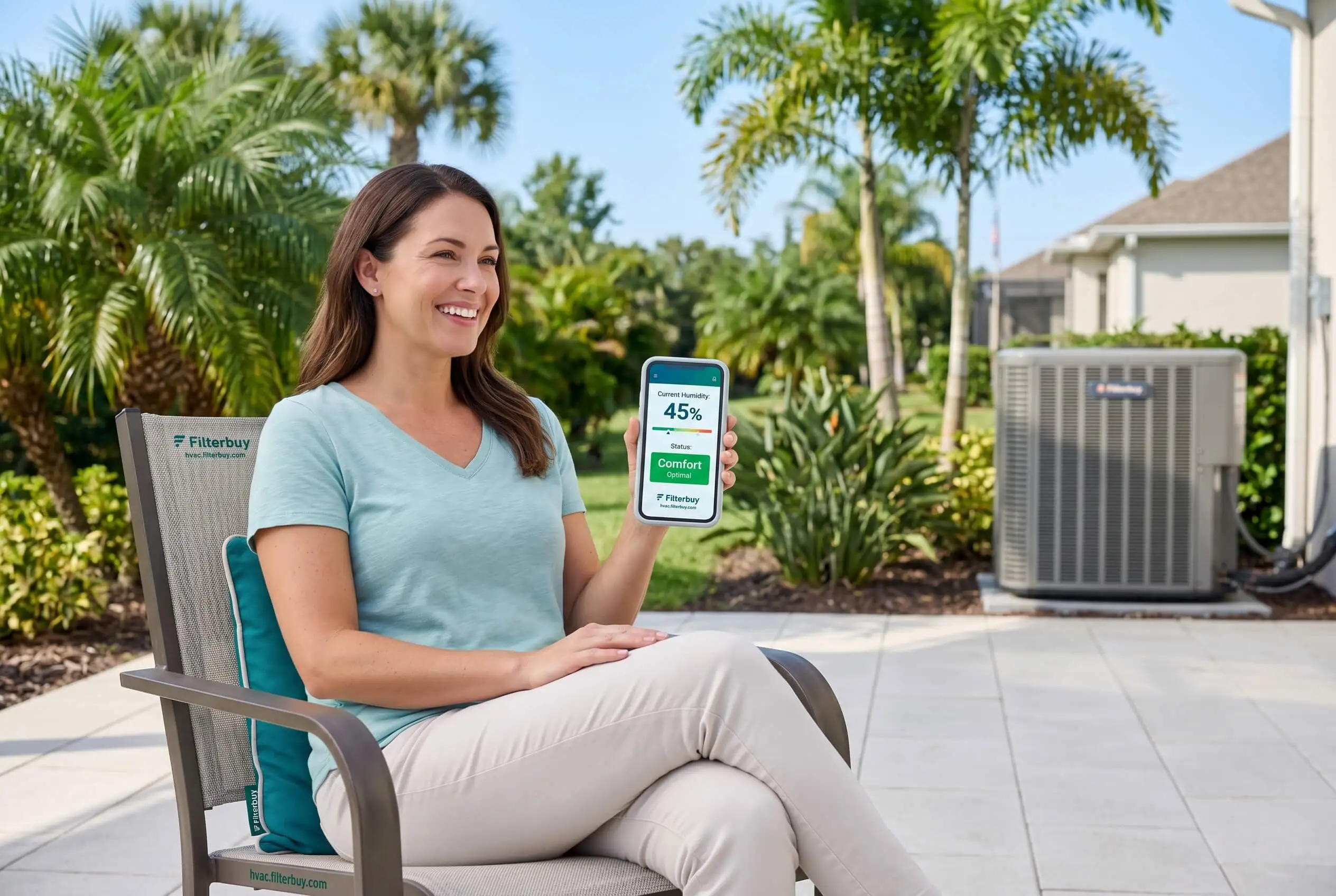
“On Clermont’s older flex-duct homes from the late 1980s and 1990s, return-side leakage is what kills the dehumidification. A dollar-coin-sized hole in a return plenum pulling 135-degree attic air will cost you 25 to 30 percent of your moisture removal capacity, and the AC will run all day trying to fix it. Find the leak, seal it, and the house drops 8 percent RH that same afternoon. Every time.”
7 Essential Resources
We verified each link below before publishing this page. Bookmark the ones that apply to your situation.
1. EPA — The Inside Story: A Guide to Indoor Air Quality
Federal guidance on indoor air quality, including the 30 to 50 percent relative humidity range recommended for residential settings.
https://www.epa.gov/indoor-air-quality-iaq/inside-story-guide-indoor-air-quality
2. ENERGY STAR — Clean Heating and Cooling
Official guidance on properly sized HVAC equipment, ACCA Manual J load calculations, and why oversized systems cause humidity control problems.
https://www.energystar.gov/products/energy_star_home_upgrade/clean_heating_cooling
3. U.S. Department of Energy — Air Conditioning
Plain-language overview of how central AC works, what drives efficiency, and the cost share of cooling in U.S. home energy bills.
https://www.energy.gov/energysaver/air-conditioning
4. Florida Department of Health — Indoor Air Quality
State-level guidance on residential indoor air quality, mold, and moisture concerns specific to Florida’s humid subtropical climate.
https://www.floridahealth.gov/environmental-health/indoor-air-quality/index.html
5. Florida DBPR — Verify a License
Search any Florida HVAC contractor by name, business name, or license number. Two minutes here will rule out unlicensed operators before any work begins.
https://www.myfloridalicense.com/wl11.asp
6. NADCA — National Air Duct Cleaners Association
Industry standards body for duct system cleaning and inspection. NADCA-certified providers follow documented technical standards rather than rule-of-thumb practices.
7. Lake County, Florida — Government Portal
Local building, permitting, and code enforcement information for HVAC work in Clermont and surrounding Lake County communities.
3 Statistics
1. The U.S. Environmental Protection Agency recommends 30 to 50 percent indoor relative humidity for homes, which holds mold, dust mites, and biological contaminants below problem levels.
Source: EPA, The Inside Story: A Guide to Indoor Air Quality — https://www.epa.gov/indoor-air-quality-iaq/inside-story-guide-indoor-air-quality
2. U.S. households spend about 12 percent of their electricity on air conditioning, totaling roughly $29 billion a year, according to the U.S. Department of Energy.
Source: U.S. Department of Energy, Air Conditioning — https://www.energy.gov/energysaver/air-conditioning
3. In Florida, 96 percent of households use air conditioning, with 90 percent relying on a central system. That’s the highest central AC adoption rate of any state, according to the U.S. Energy Information Administration’s 2020 Residential Energy Consumption Survey.
Source: U.S. Energy Information Administration, 2020 RECS State-Level Results — https://www.eia.gov/pressroom/releases/press510.php
These statistics show why homeowners rely on a top HVAC system repair provider to maintain healthy indoor humidity levels, improve cooling efficiency, lower energy costs, and keep central air conditioning systems performing reliably in Florida’s demanding year-round climate.
Final Thoughts and Opinion
Most Clermont humidity complaints we get aren’t equipment failures in the dramatic sense. They’re slow, accumulating issues that the AC eventually can’t compensate for: a drain pan that’s been algae-fouled for two summers, a return duct that started leaking after the 2018 storm season, or a coil that’s never been cleaned since the system went in. Any one of these can leave a healthy AC unable to do half of its job.
The honest opinion from our side of the service truck is that humidity-driven calls in Clermont are usually inexpensive to fix and quick to resolve. A professional HVAC repair service identifies the root cause early, completes the repair efficiently, and restores indoor comfort before the issue develops into a much larger and more expensive problem. Diagnosis runs under an hour, the repair fits into a single service call about 80 percent of the time, and the comfort difference shows up the same day. The bigger risk is letting a small problem run for a season or two. By then you might be looking at warped floors, mold in registers, and a failed compressor from running 24/7, and the eventual repair costs more than it should have.
Frequently Asked Questions
Why is my Clermont home so humid even when my AC is running?
Your AC works two jobs at once. It pulls heat out of the air, and it pulls moisture out of it. Humidity complaints almost always trace to a failure on the moisture side. The most common causes we see in Clermont are oversized systems that short-cycle, clogged condensate drains, dirty or frozen evaporator coils, low refrigerant charge, and return-side duct leakage in older attics. A licensed HVAC technician can pinpoint which one is in play within an hour.
What indoor humidity level should I keep in a Clermont, FL home?
The EPA recommends keeping indoor relative humidity between 30 and 50 percent to limit mold, dust mites, and biological contaminants. In Clermont’s wet season, holding 50 percent is more realistic than 40 percent. Anything consistently above 60 percent encourages mold growth and can damage wood floors, drywall paper, and electronics. A digital hygrometer that costs under $15 will tell you where you actually are.
How much does HVAC repair cost in Clermont, FL?
Most humidity-driven repairs in Clermont resolve in a single service call. Diagnostic visits typically run a flat fee that applies toward the repair if you proceed, and routine fixes like drain line clearing, coil cleaning, or capacitor replacement come in at the lower end of the range. Refrigerant leaks and electrical component failures run higher, especially on older R-22 systems where the refrigerant alone gets expensive.
Can a clogged condensate drain really cause humidity problems?
Yes, and it’s the single most common cause we find on Clermont humidity calls during the wet season. When the drain clogs, water backs up into the pan, the coil stays wet between cycles, and that retained moisture evaporates back into the conditioned air every time the blower runs. Even partial clogs reduce dehumidification meaningfully, and a full blockage trips the float switch and shuts the system off entirely.
How do I know if my Clermont AC is oversized for my home?
A few signs point to oversizing. Your system reaches a set temperature quickly, often under 10 minutes on a hot afternoon, but the house still feels sticky. Cycles run short and frequent rather than long and steady. Indoor humidity reads above 55 percent even though the AC ran most of the day. The definitive answer comes from a Manual J load calculation, which a licensed Clermont contractor can run in 30 to 60 minutes.
How do I verify a Clermont HVAC contractor’s license?
Visit MyFloridaLicense.com and search by license number, business name, or technician name. Florida DBPR shows the license type (CAC for certified air conditioning contractor), status, expiration date, and any disciplinary history. Unlicensed work voids most manufacturer warranties and shifts liability to the homeowner if something fails. The check takes two minutes and is one of the smartest pre-service decisions a Clermont homeowner can make.
Should I repair or replace my HVAC system if it can’t handle humidity?
Most humidity issues are repair issues. Clogged drains, dirty coils, and small refrigerant leaks resolve within a single service call. Replacement enters the picture when the system is over 12 years old and the repair quote crosses about 40 percent of replacement cost, when the system uses R-22 refrigerant, or when the home has chronic humidity problems and the existing system is single-stage. Variable-speed equipment in those cases dehumidifies far better than older single-stage systems.
Fix Clermont Humidity Problems With the Right HVAC Repair
Most humidity complaints in Clermont resolve through a single repair rather than a system replacement, and the diagnosis usually takes under an hour. Schedule a visit and we’ll work through which of the five repair categories is driving the moisture in your home.
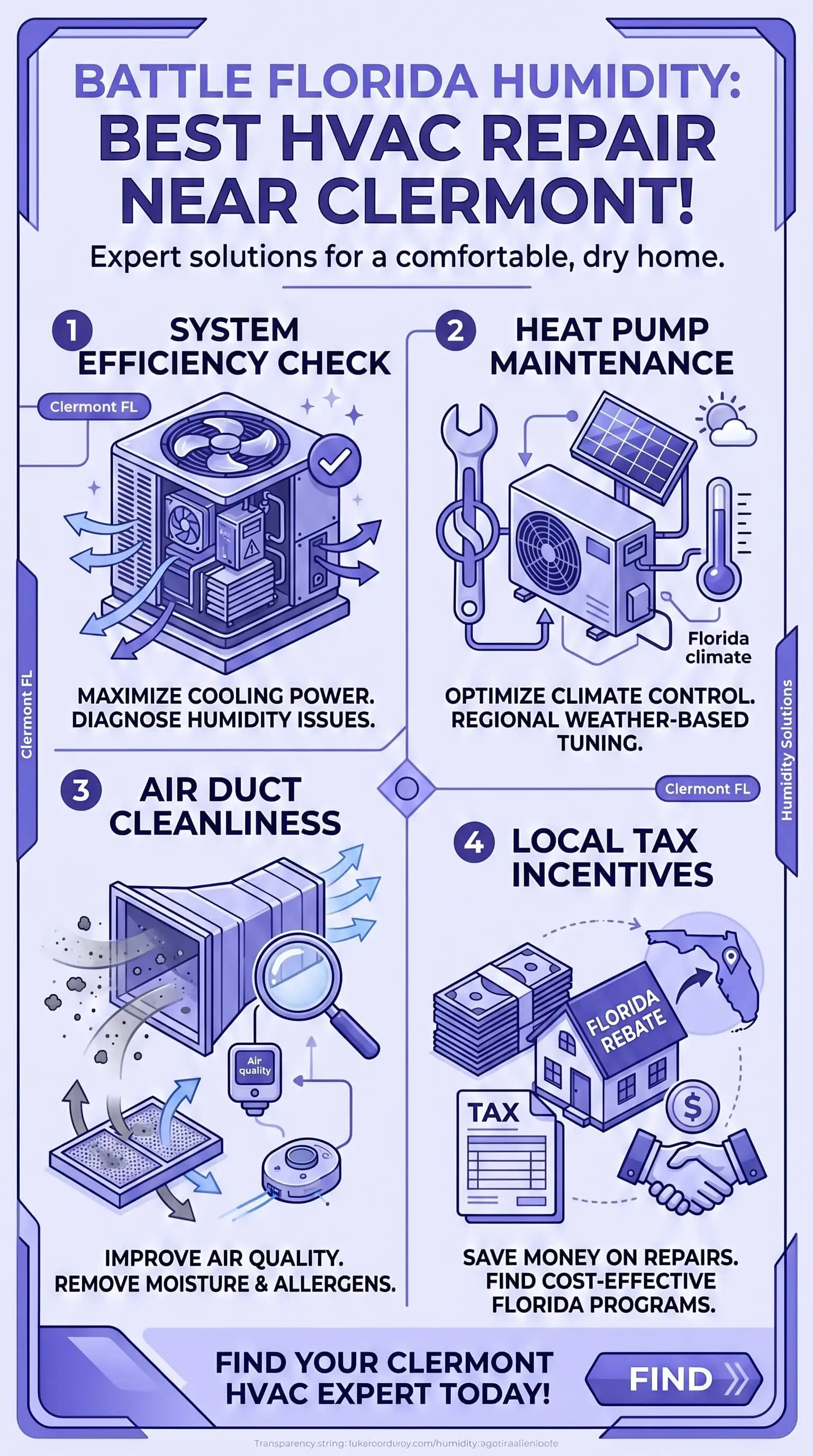
Indoor humidity problems in Florida are often tied directly to airflow restrictions and neglected filtration systems. In Best HVAC Repair Near Clermont FL for High Humidity Problems, we explain how clogged filters and poor airflow force HVAC systems to work harder while reducing their ability to properly remove moisture from the air. Replacing old filters with products like 10x10x1 pleated furnace filters, 20x22x1 MERV 8 HVAC air filters, and pleated AC replacement filters helps improve airflow, support better humidity control, and reduce unnecessary strain on HVAC components during Clermont’s long cooling season.